 Foleart
What Is Book Folding? A Beginner's Guide
Bookfolding is the art of folding a book's sheets to form raised images, names and phrases. Understand how the technique works, what you need and how to take the first steps.
Updated August 2026
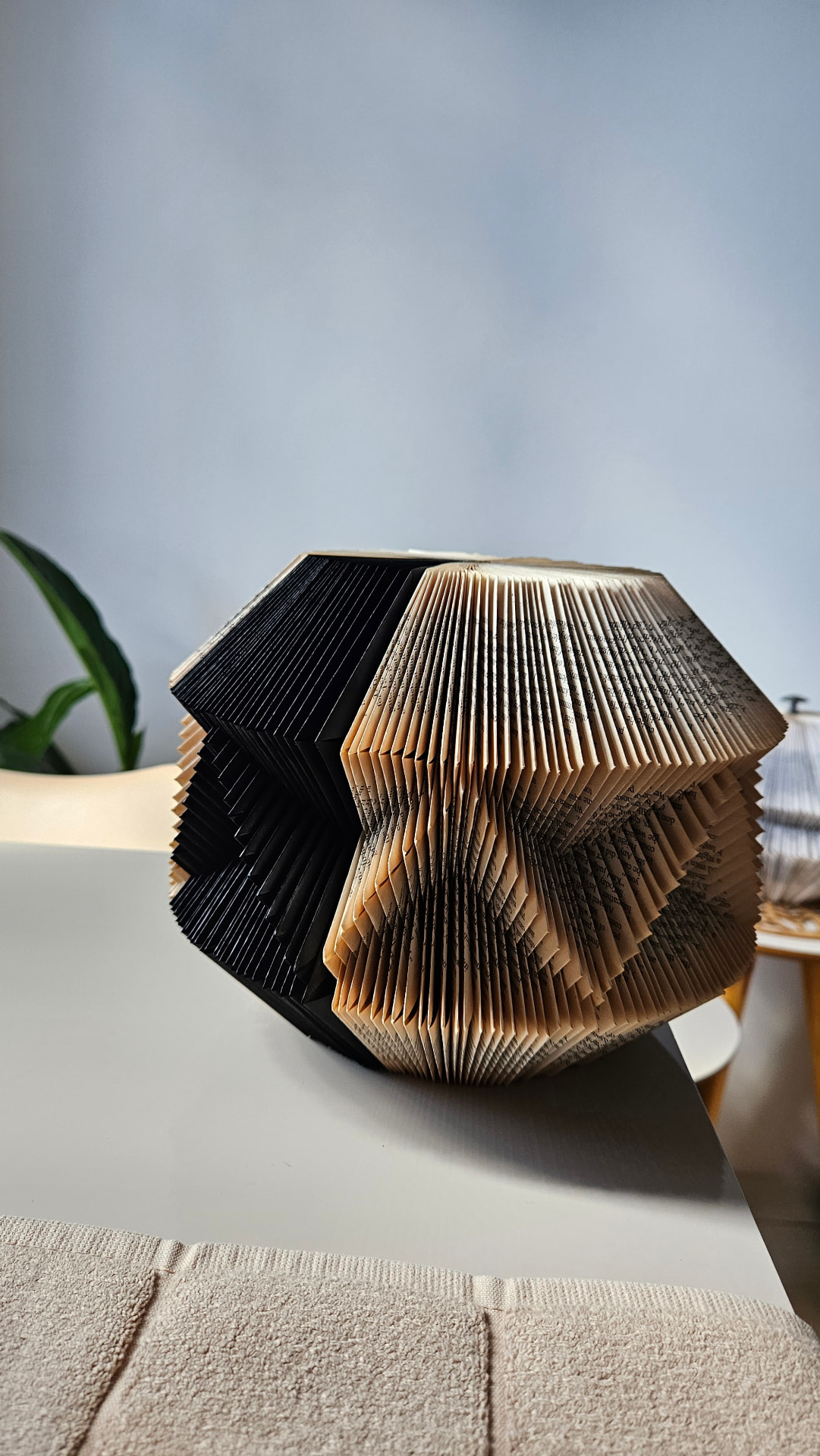
Bookfolding in one sentence
Bookfolding is the technique of folding a book's sheets one by one so the whole block forms a three-dimensional design: a heart, a name, a date, a silhouette, a symbol. The book stops being something you read and becomes a paper sculpture.
Every sheet gets two marks — where the fold starts and where it ends. When all the sheets are folded at the right positions, the aligned creases draw the outline of the figure. Hundreds of simple folds add up to one image.
What you need
- A hardcover book with enough sheets for the chosen figure (usually between 200 and 400 sheets).
- A pattern — a model that guides you, sheet by sheet, where to mark the folds.
- A pencil and a bone folder (or the back of a spoon) to press the crease.
- Patience: your first pieces will take a few hours.
The point where most beginners get stuck
It is not the folding — it is the marking. In the traditional method you measure every sheet with a ruler and transfer two millimetre values to hundreds of pages. A 2 mm error repeated dozens of times distorts the whole figure.
That is exactly the step the Foleart Method removes: the generator turns an image or a word into a printed pattern, recalculated for the sheet count and the height of your book.
How long does a piece take?
Execution time depends less on the complexity of the figure or letters and more on the number of sheets in the book. Most projects are completed in about 2 hours.
What it is used for
Bookfolding is widely used for personalised gifts — weddings, birthdays, anniversaries, baby names, tributes — and also as a side income: custom pieces carry high perceived value because they are unique and handmade.
Next step
If the idea makes sense and you want to build one, move on to the full step-by-step guide: choosing the book, generating the pattern, marking and finishing.